Who are the Big Three at Yonkers city hall? Many would say they are Mayor Mike Spano, City Council President Lakisha Collins-Bellamy and Council Majority Leader John Rubbo.
In this column — where we’re talking trees — that would be wrong.
Instead, meet the real Big Three:
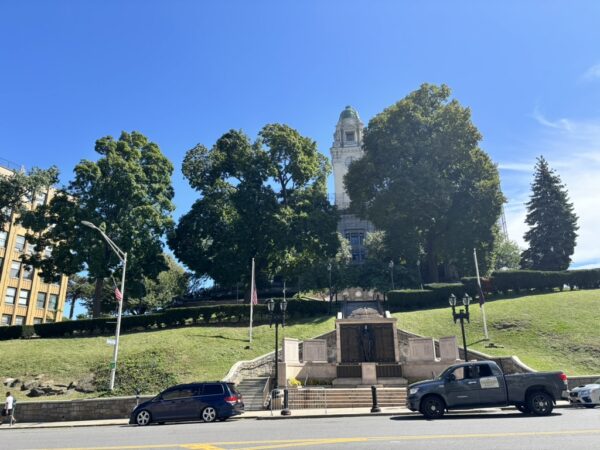
Please ignore the crooked Christmas tree on the far right that seems to be slightly bowing to his or her superiors. It’s simply not on the same level as any of the Big Three.
Let me introduce you to these mighty trees, from left to right in the photo: the City Hall Sugar Maple, the City Hall Norway Maple, and, the star of the show, the City Hall American Basswood. All are special, and you should get to know them.
I am on a quest to discover 100 interesting Yonkers trees. So I went to Washington Park to reconnoiter, saw the trees and began to wonder if any could have been living before city hall construction began in 1907. I immediately recognized that these three were the only candidates. If one or more predated the building of city hall, just imagine the Yonkers history they witnessed.
Putting on my pseudo-scientific thinking cap, I had to figure out how to measure these big mamas and estimate their age, without any tools. Here are the dimensions that I came up with:
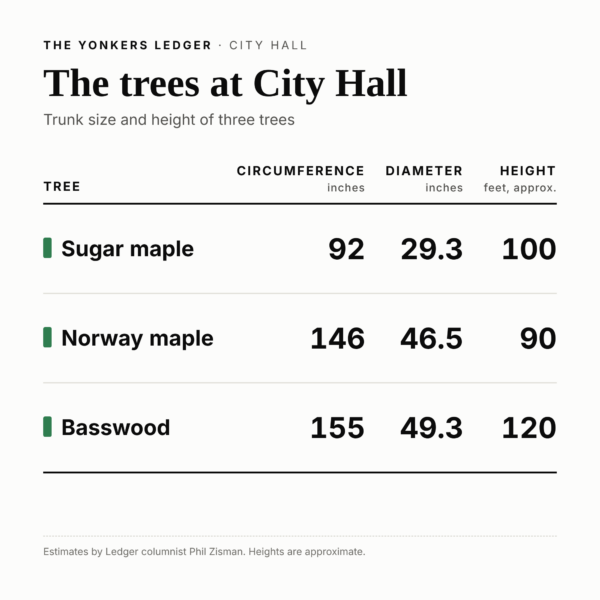
For those of you interested in the science of my field work read the next paragraph. For those who don’t care, skip it.
In Which the Author Explores Wingspan, Diameter, Circumference and Height
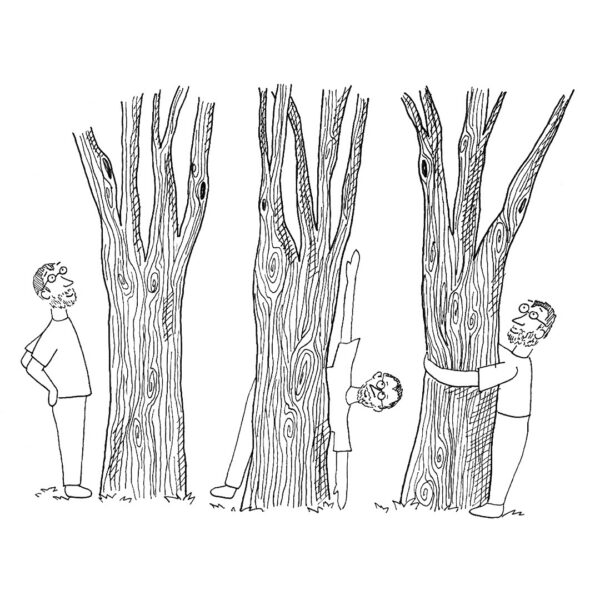
The circumference was measured at 4.5′ off the ground at breast height — the standard used by the U.S. Forest Service. Since I didn’t have a measuring tape, I used my 65” wingspan as my measuring tool. I hugged my way to the numbers. (For example, when I hugged the sugar maple, I could encircle the tree with one complete wingspan, from fingertip to fingertip, + an additional arm’s length of 27”. So, 65” + 27” = 92”.) I determined the diameter by dividing the circumference by π (92”÷3.14=29.3”). I estimated their approximate heights by comparing the relative size of each tree to the height of city hall, which I know rises 164′ from its base on the top of the hill at Washington Park, and took into account the fact that the trees were situated approximately 20′-25′ below the base of city hall. I readily acknowledge that these are not exact measurements.
Pampered Beauty
Regardless of the accuracy of my calculations, these are indeed magnificent trees. They have benefited from growing in full sun, having space for themselves, and being cared for, dare I say pampered, by a succession of city arborists. That’s a winning recipe for long-lived and fast-growing trees. Simply put, these are tall, mature trees with impressive spreading crowns that capture a significant portion of the sky. Go back to the photo and take a moment to appreciate how great they truly are. They have earned their place in my growing list of interesting trees in Yonkers.
But how old are they? Height and girth by themselves do not provide enough information to determine a tree’s age. That requires additional research.
In Which the Author Explores Growth Factors
Tree scholars have designed a formula for determining age based on a tree’s diameter. They have assigned growth factors to many different tree species. The factor can be thought of roughly as the number of years represented by each inch of accumulated trunk diameter. A fast-growing species gets a lower number; a slower-growing species gets a higher one. To determine age, you multiply the diameter by the growth factor.
Here’s a chart applying the tree growth formula to our Big Three to determine their ages:
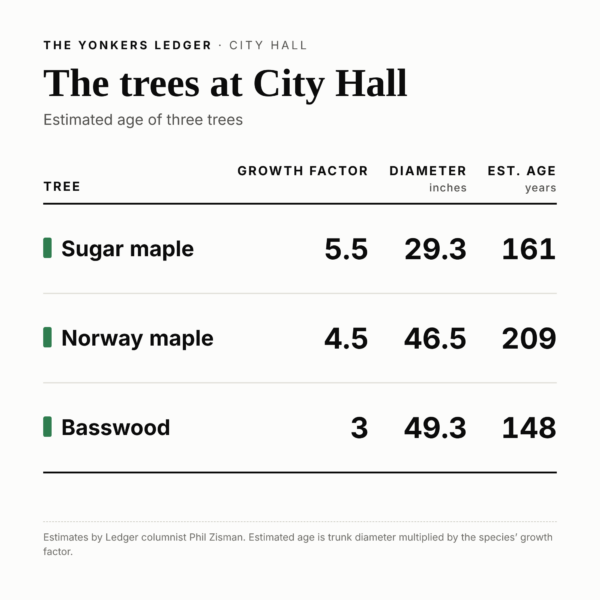
But as soon as I did the calculations, I thought they couldn’t be right. I sensed that the tree factors, especially for the two maples, were inapplicable. My instincts told me that because the Big 3 have lived in ideal conditions, it was highly likely they grew significantly faster than the typical trees of their species growing in less-than-ideal conditions and therefore were much younger. Think of a woodland tree competing with other trees for a piece of the canopy. Their growth rate is significantly different from the rate for the Big 3. Thus, it seemed improbable that this Norway maple was 209 years old or the sugar maple 161 years old. The basswood estimate, however, at 148 years, appeared more plausible.
Back in Time
To confirm my suspicions, I turned to the internet to search for historical photographs of Yonkers City Hall. I was looking for pictures of the building around the time of construction. I wanted to see if I could unequivocally establish that these trees existed during construction, which started in 1907, 119 years ago.
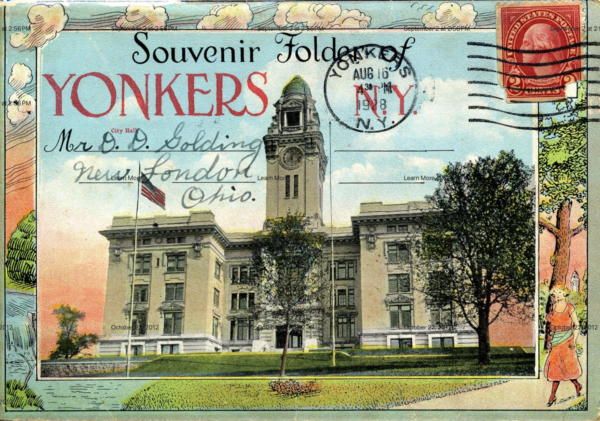
The most revealing photograph I found was from a postcard that Len Holsborg recently posted on Facebook. The card came from a series that was originally printed circa 1915, just eight years after city hall construction began. Notice that the postmark indicates that the card was sent in 1928, much later than its original printing, and also note that the central staircase that leads from the War Memorial on South Broadway up to the central entrance to city hall was not yet constructed — that came later in the early 1930s.
As for the Big Three, it’s evident that only the Norway maple and basswood are present. The Norway maple would appear to be about five to seven years old, and could have very well been planted as part of the landscaping after city hall was completed in 1910. The basswood, on the other hand, is already a mature tree, with its central trunk and crown well developed, suggesting that it is at least 30 to 40 years old. It appears the sugar maple was yet to be planted.
The Envelope Please
Based on this and a few other photos not included here, I believe that the sugar maple was planted around 1920 and is now 106 years old; the Norway maple was planted in 1910 and is now 116 years old, and the basswood, the granddaddy of them all, began its life in 1880 and is now 146 years old. In the late 1880s, the land was part of the Nisbet estate that predated city hall.
And now just a few fun facts about sugar maples, Norway maples and American basswood trees:
· The sugar maple is New York’s state tree. The City Hall Sugar Maple is a wonderful specimen, but I know there must be larger examples in Yonkers. Help me find them.
· The Norway maple is considered an invasive species because it can outcompete native trees. Norway maples tend to leaf out earlier in spring and hold their leaves later in fall than many native trees, giving them a longer growing season. This may explain, in part, its explosive growth in Washington Park.
· The American basswood produces massive amounts of flowers which are particularly attractive to bees. It is sometimes referred to as the “bee tree.”
If anyone has other historical photographs of these trees that support or dispute my findings, I’d love to see them.
(Note: The two charts in this story were created by AI with data provided by editors.)