
Election Day is less than three weeks away, and I suspect many Yonkers voters still don’t know much about the candidates.
Campaign mailers flood our mailboxes, but they’re of little help in telling the candidates apart.
Everyone promises to make Yonkers and Westchester more affordable. They want better schools, lower utility bills, safer neighborhoods, more jobs, improved infrastructure and more housing — as long as it doesn’t bother any constituents. They all proclaim that they know how to get things done.
In this series, the Yonkers Ledger follows the money in order to give voters another way to consider these candidates. We have researched the details of the candidates’ required financial disclosures to determine how much money their campaigns have collected, and who gave it to them.
We look at the four state and local campaigns:
- New York State Senate, District 35: Democratic incumbent Andrea Stewart-Cousins vs. Republican Anthony Merante.
- New York State Assembly, District 90: Democratic candidate Frank Jereis vs. Republican John Isaac, competing for the open seat being vacated by Nader Sayegh.
- Westchester County Board of Legislators, District 15: Republican incumbent James Nolan vs. Democratic opponent Kisha Skipper.
- Westchester County Board of Legislators, District 17: Democratic candidate Wilson Terrero vs. Working Families Party candidate Leslye Oquendo-Thomas, competing for the seat being vacated by José Alvarado.
What Campaign Contributions Can Reveal
Running for office is expensive, particularly for first-time candidates. Campaigns need money for mailings, digital advertising, signs, staff, and consultants.
Well-funded candidates can generally promote themselves to more voters, more frequently. Campaign-finance disclosures tell us who has run the races with the most resources. And they also tell us something else:
Where that money comes from.
Who is contributing to the campaigns? Ordinary people? Labor unions? Political action committees? Developers and real estate interests? Businesses and political organizations? The disclosures also tell us about the donor who this year is supplying more than 40 cents of every dollar in these four races:
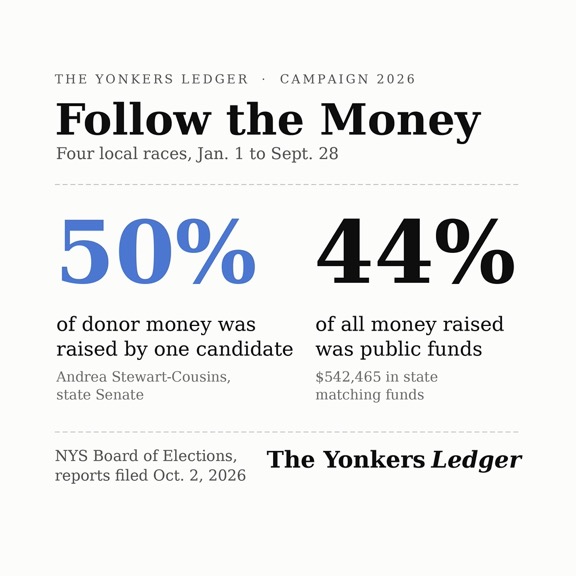
You, the taxpayer, through public matching funds awarded to candidates under the state’s public campaign finance program, enacted in 2020 and now in its second election cycle. The state provided $542,500 in public matching funds for the races we look at in this series, as compared to $687,700 from donors. Half of that donor money, $341,621, went to one candidate: Senate Majority Leader Andrea Stewart-Cousins.
(For voting information, please see our voter information box below.)
How We Examined the Money
In New York state, campaign contributions and expenditures are public information. Candidates and their campaign committees must file financial disclosures with the State Board of Elections, which makes the reports available through an online database.
The disclosures are snapshots, not final campaign accounts. For this series, we examined available campaign-finance disclosures for 2026 through Sept. 28. Additional reports are due before and after Election Day, and previously filed disclosures can be amended.
Campaign contributions do not necessarily determine how an elected official will vote. Nor does a contribution establish that a donor has received or expects a particular favor. But financial support can help identify the individuals and organizations investing in a candidate’s success and the interests that may seek access to that candidate after the election.
A large contribution is not proof of improper influence. It is, however, a legitimate subject of public scrutiny.
How Public Matching Funds Work
As part of this review, we also examined the public matching fund payments. Candidates running for the state Senate and Assembly may qualify for the public campaign financing.
The program is intended to increase the importance of smaller contributions. For qualifying donations, the first $50 is matched at 12-to-1 (for every $1 contributed, the candidates received $12, up to $600). The next $100 is matched at 9-to-1, and the following $100 at 8-to-1.
That means a qualifying $250 contribution can generate $2,300 in public matching funds, giving the campaign $2,550 altogether.
Candidates must meet minimum fundraising and contributor requirements, comply with program rules, and submit to financial reporting and auditing. To qualify for the program, a candidate has to raise $6,000 from at least 75 district residents for Assembly candidates, and $12,000 from at least 150 district residents for Senate candidates, with reduced dollar thresholds in qualifying lower-income districts.
Public matching funds for each election are generally capped at $175,000 for Assembly candidates and $375,000 for Senate candidates, subject to restrictions and adjustments. A candidate who participates in both a primary and general election may receive funding for both elections.
The program applies to state legislative races, not the two Westchester County Board of Legislators races examined here.
The first installment of this series examines the race between Andrea Stewart-Cousins and Anthony Merante for New York State Senate District 35. The accompanying charts compare reported fundraising, sources of contributions, public matching funds and campaign spending where the records permit.
Andrea Stewart-Cousins (Democrat)
Andrea Stewart-Cousins was first elected to the state Senate in 2006 and serves as Senate majority leader, a position she has held since 2019. A former Westchester County legislator, she made history as the first woman and first African American woman to lead the New York state Senate.
Her rise in state politics included two closely contested election battles with longtime Republican state Sen. Nicholas Spano, a member of one of Yonkers’ most prominent political families and the older brother of current Mayor Mike Spano. Stewart-Cousins narrowly lost to Spano in 2004 but defeated him in a 2006 rematch, ending his two-decade tenure in the Senate. The victory marked an important shift in the political balance of power in southern Westchester and helped establish Stewart-Cousins as a significant figure in the state Democratic Party.
As Senate majority leader, Stewart-Cousins now occupies one of the most influential positions in New York government.
In the most recent budget cycle, Stewart-Cousins has asserted that under her leadership the state budget includes more than $1 billion in aid for local governments outside New York City, including $163.2 million for the City of Yonkers, 44% more than the year before, money that helped close a school budget gap that threatened layoffs.
Anthony J. Merante (Republican)
Anthony Merante is a certified public accountant, businessman and former Yonkers City Council member who represented the city’s 6th District beginning in 2018. Merante has emphasized fiscal responsibility, lower taxes, government accountability and public safety throughout his political career.
One thing that Merante and Stewart-Cousins have in common: they both ran against a Yonkers Spano. In 2023, Merante challenged incumbent Democratic Mayor Mike Spano, Nick’s younger brother. The campaign focused heavily on term limits after the Yonkers City Council voted to allow the mayor to run for a fourth term. Merante opposed the extension and campaigned on restoring term limits. He lost to Mike Spano by approximately 61% to 36%, allowing Spano to secure an unprecedented fourth four-year term as mayor.
Even though registered Yonkers Democrats outnumber Republicans by a margin of 3 to 1, Merante is not afraid to run against the odds. He believes that as part of a strong democracy, voters need to have a choice when they go to the polls. He believes that by taking on Majority Leader Stewart-Cousins, he is helping the Republican candidate for governor Bruce Blakeman.
The Yonkers Ledger · Follow the Money · Campaign 2026
State Senate, District 35
Democratic incumbent Andrea Stewart-Cousins vs. Republican Anthony Merante
Money in and out, 2026 so far
Jan. 1 through Sept. 28, from every report each campaign has filed this year. Public funds come from the state’s matching program for legislative races.
Where the donations came from
Same period. People are grouped by how much each gave in total this year. Business includes law and accounting partnerships.
Stewart-Cousins
| Donors who are people | 199 |
| Typical gift per person (median) | $100 |
| Most from any one person | $10,000 |
| Money from people with Yonkers addresses | $3,200 (3%) |
| Sent to the DSCC | $100,000 |
Merante
| Donors who are people | 326 |
| Typical gift per person (median) | $75 |
| Most from any one person | $750 |
| Money from people with Yonkers addresses | $28,579 (82%) |
Largest donors, by candidate
Andrea Stewart-Cousins · Anthony Merante (PDF, opens in a new tab)
Source: New York State Board of Elections campaign finance filings for 2026, through the 32-Day Pre-General reports filed Oct. 2, 2026. Colors show party: Democrats blue, Republicans red, Working Families Party green. Analysis by The Yonkers Ledger.
What the Financial Disclosures Reveal: Two Campaigns Operating on Different Scales
The campaign-finance disclosures of Stewart-Cousins and Merante reveal substantial differences in fundraising, spending and financial resources. But comparing the two candidates solely by the numbers would be a mistake.
Stewart-Cousins is not simply an incumbent seeking reelection. She is the majority leader of the New York State Senate, a position that makes her one of New York’s most powerful politicians and gives her a statewide political role extending well beyond her Yonkers-based district.
Her fundraising network includes labor unions, corporations, PACs, and professional associations. Many of her contributors are statewide political players who want to stay on the good side of the Senate majority leader, and their support for the Senate majority leader is part of a broader political strategy than if they were simply supporting a candidate for a single Senate seat.
Merante’s disclosures, by contrast, show a candidate depending on small individual donations that he received from 326 named individuals during 2026, compared with 199 for Stewart-Cousins. Yet Stewart-Cousins collected $104,921 from individual contributors, more than three times Merante’s $34,844.
Organizational contributions further distinguish the campaigns. Stewart-Cousins received $92,800 from unions and $122,500 from business and professional donors, including law and accounting partnerships. Organizations supplied 69% of her $341,621.
The records also reveal how Stewart-Cousins’ campaign finances extend beyond her own reelection effort. On Sept. 16, her campaign reported transferring $100,000 to the Democratic Senate Campaign Committee. That transaction represented nearly a third of the $329,476 her campaign paid out this year. Rather than spending all of her campaign funds on her own race, Stewart-Cousins also directed resources to a broader state Democratic organization.
The largest financial difference, however, is money accumulated over time. As of Sept. 28, Stewart-Cousins reported $1,168,926 in available campaign cash, compared with $22,456 for Merante. Her balance reflects fundraising and unspent resources from previous election cycles, not simply contributions received during 2026.
Stewart-Cousins was in a strong enough position to not take public matching funds. Merante’s campaign reported receiving $171,006 in public matching funds through Sept. 28.
Taken together, the disclosures show two campaigns with different fundraising structures. Stewart-Cousins is a powerful fundraiser who benefits from an established donor network, substantial accumulated reserves and a statewide leadership position. In contrast, Merante’s campaign relied on small, individual contributors, which qualified him for a significant amount of public campaign matching funds.
How this was made
Editors used AI tools to collect and analyze campaign finance data and to build the charts. All editing decisions were made by human editors, who checked the results against the candidates’ filings with the State Board of Elections.
Sat., Oct. 24 — Last day to register to vote. Also the last day for the Board of Elections to receive a mail ballot application sent online or by mail.
Oct. 24 – Nov. 1: Early voting. Any registered voter can vote at any of the county’s 25 early voting sites. In Yonkers: Grinton I. Will Library, 1500 Central Park Ave.; Nodine Hill Community Center, 140 Fillmore St.; Riverfront Library, 1 Larkin Center. Hours: Sat. & Sun. 10 a.m.–6 p.m.; Mon., Wed., Fri. 8 a.m.–4 p.m.; Tue. & Thu. noon–8 p.m.
Mon., Nov. 2 — Last day to apply for a mail ballot in person at the Westchester County Board of Elections, 445 Hamilton Ave., 8th Floor, White Plains.
Tue., Nov. 3: Election Day. Polls open 6 a.m.–9 p.m. at your assigned polling place only. Mail ballots must be postmarked by Nov. 3 and received by Nov. 10, or dropped off at a polling place or the Board of Elections by 9 p.m.
Note: If you were issued a mail ballot, you can’t vote on a machine in person. You can still vote at the polls with an affidavit ballot.
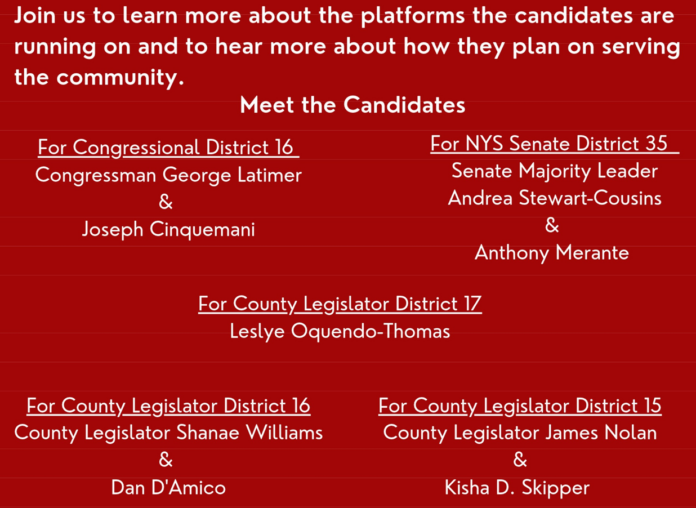
Our Campaign 2026 series covers State Senate District 35, Assembly District 90 and County Legislature Districts 15 and 17. Here are the other races Yonkers voters will see. District races depend on your address; Vote411 shows your exact ballot.
- Governor and Lt. Governor: Kathy Hochul and Adrienne Adams (D, WF) vs. Bruce Blakeman and Todd Hood (R, C, Vote Affordable)
- Attorney General: Letitia James (D, WF) vs. Saritha Komatireddy (R, C)
- Comptroller: Thomas DiNapoli (D, WF) vs. Joseph Hernandez (R, C)
- Congress, 16th District: George Latimer (D) vs. Joseph Cinquemani (R)
- State Senate, 37th District (northeast Yonkers): Shelley Mayer (D, WF) vs. Thomas Fix Jr. (R)
- Assembly, 89th District (part of Yonkers): Gary Pretlow (D), unopposed
- Assembly, 92nd District (northwest Yonkers): MaryJane Shimsky (D, WF) vs. Bob Welch (R, C)
- County Legislature, 14th District: David Tubiolo (D) vs. Bebe Ahmed (R)
- County Legislature, 16th District: Shanae Williams (D) vs. Dan D’Amico (R, C)
- State Supreme Court, 9th Judicial District (vote for three): Maria Rosa (D, WF), George Fufidio (D, R), Alden Wolfe (D, C), Richard Fava Pastilha (R, C), John Ciampoli (R)
- Yonkers City Court Judge (10-year term): Alexandra Bisesi (D, C), unopposed


What the filings show
Stewart-Cousins has raised $341,621 this year and had $1,168,926 in the bank on Sept. 28, about 52 times Merante’s $22,456. Organizations supplied 69% of her donations: $122,500 from business and professional donors, including law and accounting partnerships, and $92,800 from unions. Only $3,200 came from people with Yonkers addresses. She also sent $100,000 to the DSCC. Merante has raised $34,944 from 326 donors, none giving more than $750, and 82% of their money came from Yonkers addresses. Public matching funds pay for most of his campaign: $171,006 through Sept. 28, by his committee’s reports.