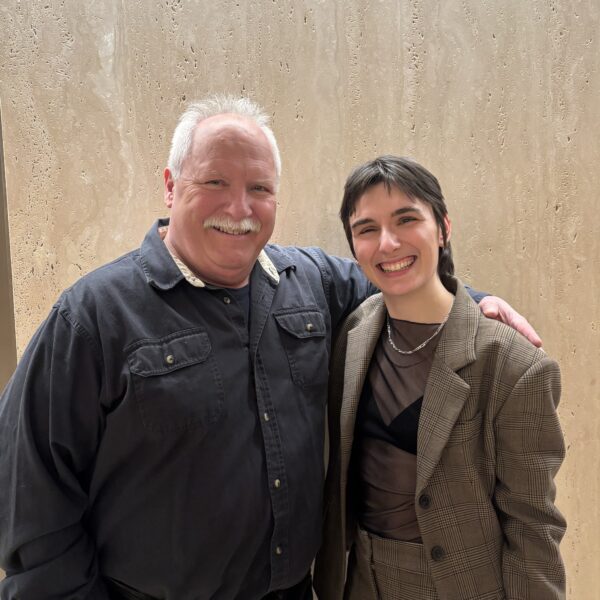
I first met Angela Brown when she was in college. Angela and my older daughter became close friends, and it was a pleasant coincidence that Angela also grew up in Yonkers. I always knew Angela was headed for greatness.
She also was the central figure in one of my favorite local mysteries. In elementary school at PS 22, Angela was showing great artistic talent. In the 5th grade, she made a colorful abstract collage that appeared in an exhibit at the Will Library. After the exhibit closed, the picture mysteriously vanished. Years went by. Angela graduated from Yonkers Middle High in 2012. The picture most likely forgotten.
Then, almost 20 years later, a shocking discovery. Angela’s brother Andrew was walking through a hallway in the City’s offices at the Riverfront Library, and there on the wall was the picture. He told their father Fran, who confirmed that it was indeed Angela’s long-lost library work. Fran reclaimed it as a family heirloom. It now hangs proudly in the Browns’ Dehaven Drive home.
Times Flies and Angela Comes into Her Own
Fast forward. Angela’s rise in the art world has continued, through college, a PhD from Princeton, and now to the 27th floor of a building overlooking Central Park. A building, I might add, that is on Billionaire’s Row. Angela has made her debut as a curator.
I spoke with Angela and Fran, as we sipped wine at the opening of Angela’s exhibit at the prestigious Soloviev Foundation Gallery. It was then that Fran told me the story of the rediscovered painting, and I couldn’t help thinking that the Yonkers library show and her new gallery show were cosmically connected. For a 5th grader having your artwork hung in the Will is a big deal, and now for Angela, an art historian with a newly minted PhD, this upscale gallery exhibition was an equally big deal.
Angela’s show Made in Tension will be on display through December 2026. Guided tours are free, but reservations are required. 9 West 57th Street. Contact gallery@solovievfoundation.org
A Conversation
Now that Angela is all grown up, I think it’s better if I let her speak for herself. What follows is a conversation we recently had:
Q and A
So Angela, tell me about your new show? What was your inspiration and explain your process for selecting pieces and weaving them together into a single concept? (Sorry for the pun.)
The show, titled Made in Tension, is my response to a recent boom in textile-focused exhibitions, some of which position non-Western textiles as inspirations for modern art. It brings together work from the private collection of the Soloviev Foundation, including works by Pablo Picasso and Henri Matisse, textiles from South America between the 10th and 15th centuries, beadwork from 19th century Nigeria, and more.
Instead of perpetuating the idea that these textile practices are separate from the artistic processes used in modern and contemporary art, I saw the exhibition as an opportunity to show how paintings, sculptures, and photographs act like textiles, rather than the other way around. I invited fourteen contemporary artists to participate in the show, creating dialogues around physical properties of textiles: stringing, interlocking, weaving, and fragmenting.
I’ve been working on these ideas for about six years now, as my doctoral research at Princeton focuses on the role of Indigenous textile techniques in the teaching of modern art in the U.S., Mexico, and Puerto Rico.
When did you know you wanted to be an art historian?
Before I went to college, I always thought I’d be a painter. In fact, my drawing professor from undergrad was at the Made in Tension opening, and she asked me if I was still making art of my own. I dabble a bit in videography and painting now and then, but writing about art is now my focus.
Though I didn’t take my first art history class until my sophomore year in college, I actually wrote my first art history paper in high school, about German Expressionism. It was for an independent research project that I needed to complete the IB program at Yonkers High, and I chose the topic because I was curious about combining my interests in visual art and history.
But it was at college when I fully leaned in. There was a kind of magic to the way my professors transformed the classroom into a full sensory experience: detailed images on the screen paired with lectures that jumped from historical context, to poetry and philosophy, to deep analysis of visual detail. I wanted to be part of that magic-making.
Tell me about growing up in Yonkers. How did your life in Yonkers influence who you are today?
I feel really grateful to have grown up in Yonkers. I was able to have the experience of running around in the woods one day, then getting on the subway and exploring New York City the next. Now that I’m an educator, I notice more and more the ways that my upbringing gave me access to so many slices of human experience, because I’m able to relate to students from vastly different backgrounds. My grandma on my mom’s side was from Puerto Rico and spoke to me in Spanish when I was little. Then, at school, I made friends whose families spoke Arabic and Hindi and Portuguese and Polish. I think a lot about how just going to playdates at friends’ houses gave me a global perspective from a young age.