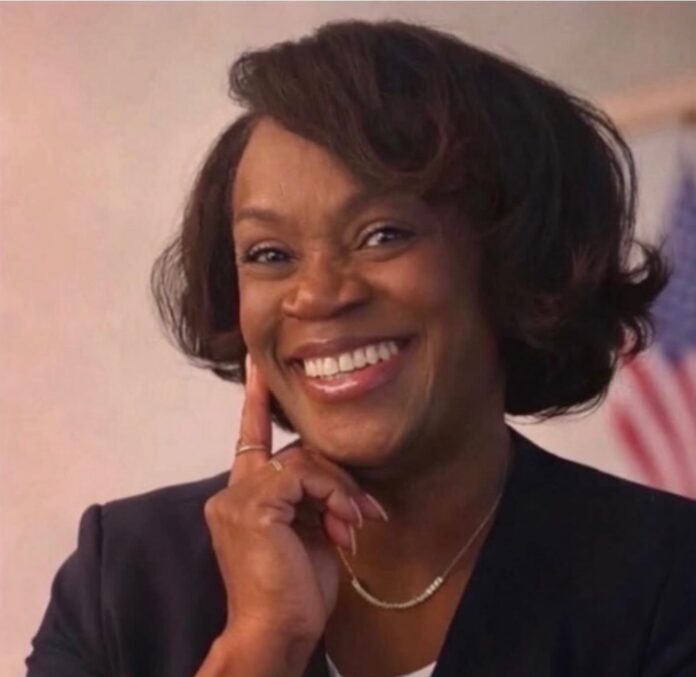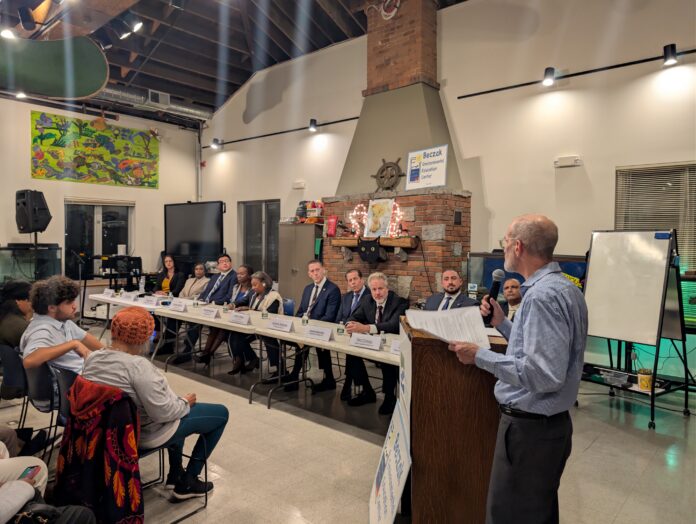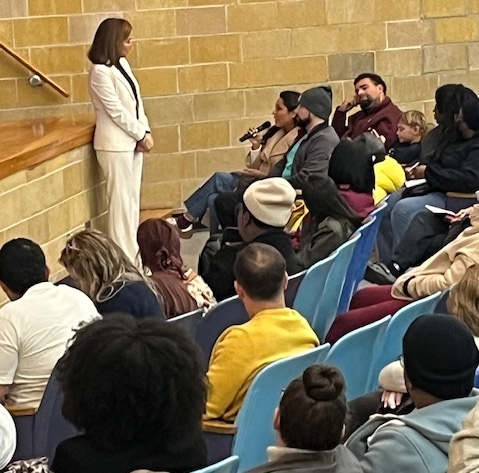
Cecilia Alcantara strode up and down the stage, microphone in hand. “How many of you pay rent to your landlord, that’s paying their mortgage?” she called. Hands flew up all over the room. “Now the city is giving you the opportunity to pay your own mortgage.”
About 300 aspiring home buyers sat in a library auditorium, focused as Alcantara, of the nonprofit Westchester Residential Opportunities, pitched a new city-backed down payment assistance program dubbed Own in Yonkers.
One raised hand belonged to Heily Fuentes, a 26-year-old hospital employee and lifelong Yonkers resident struggling with rising rent. She came to the evening session in her scrubs. The program “could help let me stay here in Yonkers just a little bit longer,” Fuentes says.
The program lends first-time home buyers up to 19% of a home’s purchase price. The loan is interest-free and is forgiven entirely after five years. Buyers are required to chip in 1% out of pocket. Qualifying property types include single-family homes, condos and co-ops.
Those who qualify are limited to $125,590 in down payment assistance, with total property value capped at $661,000 as of October 2026, according to the program’s website. But individual limits will depend on the pre-approval amounts applicants can secure, Alcantara says.
Through the city’s partnership with the nonprofit, home buyers also receive counseling. Participating lenders offer closing cost assistance.
New Push Focusing on Home Ownership
The program is one of two recent local initiatives aimed at making home ownership attainable for moderate-income Yonkers residents. The second effort — a push to expand affordable for-sale housing stock — is led by the Municipal Housing Authority for the City of Yonkers.
About 55% of the city’s renters pay 30% or more of their income for housing, and almost 30% pay half or more, according to Census Bureau American Community Survey estimates for 2020-24. Homeowners face a lower burden: about 34% pay 30% or more of their income toward housing costs.
According to Alcantara, who is co-director of counseling services at the nonprofit, the program received more than 2,500 inquiries after it was announced. The Nov. 9 info session was moved to Grinton I. Will Library on Central Park Avenue to accommodate the interest. Turnout was so high that cars circled the library lot looking for a parking spot.
Of the 2,500 inquiries, Alcantara expects only about 50 to 100 to make it through the application process. Fewer will end up in a new house. The program’s funding is limited.
Helping the “Missing Middle”
The program targets “the missing middle,” says Andrew Smith, the deputy executive director at the nonprofit. Those who earn too much for subsidized rental housing, and who may even be able to qualify for a mortgage, often still struggle to cover up-front costs, Smith says.
Applicants must earn at or under 120% of the Westchester County area median income — $142,450 for a single-person household and $203,550 for a family of four. They must also secure pre-approval for a mortgage from one of the program’s participating lenders.
Applicants must have lived in Yonkers for at least a year, have a parent who has lived in Yonkers for a year or more, or own a business in the city. They must also earn a home buyer education certificate through the nonprofit or another approved agency.
A similar program in New Rochelle, also administered by the nonprofit, targets those earning at or under 80% of the area median income. Since 2022, the program has produced just 12 successful closings, Alcantara says.
To create Own in Yonkers, Mayor Mike Spano took inspiration from New Rochelle, says city communications director Christina Gilmartin.
The program will rely on funding from the U.S. Department of Housing and Urban Development, Gilmartin says. Own in Yonkers is guaranteed funding for only two years, she says. The total amount allocated for the program is not finalized, Gilmartin says in an email.
During the Q&A portion of the Will Library session, the audience raised questions about available housing stock in Yonkers. Zillow lists 233 houses, condos and co-ops for sale under $661,000 in Yonkers as of Tuesday evening. Only 23 of the 233 are single-family homes.
“Yonkers hasn’t offered us … a lot when it comes to housing,” says Arlene Alcindor, a Yonkers resident who attended the session. “Fifteen years ago, they built those houses on Ashburton [Avenue], and there’s a few projects they had, but it felt like once you lost the opportunity we’ve been waiting forever.”
A Shift Toward Ownership
Affordable housing is scarce in Yonkers. The New York State government’s affordable housing website shows five open waitlists for affordable housing in Yonkers. Of the five, two are co-ops and one is for seniors only. The Yonkers Section 8 housing voucher waitlist is closed, according to the city housing authority’s website.
Against that backdrop, the city is emphasizing ownership, with guidelines that raise the target income range. In March, the City Council amended the city’s affordable housing ordinance to direct all new affordable for-sale housing to households earning 80% to 120% of the area median income. No affordable ownership units have been built since the ordinance was first adopted in 2013, according to city planning board meeting minutes.
Previously, the ordinance did not distinguish between affordable rental and ownership housing. It split all affordable housing into three income bands, ranging from 40% to 100% of the area median income.
This change more accurately reflects the income needed to buy a house, Gilmartin says in an email. “Typically an income at 80% of [area median income] is the lowest tier of income which could qualify for a mortgage,” she writes.
Building on Empty Lots
The housing authority’s initiative aims to fill gaps in the city’s affordable stock for home buyers by promoting new construction.
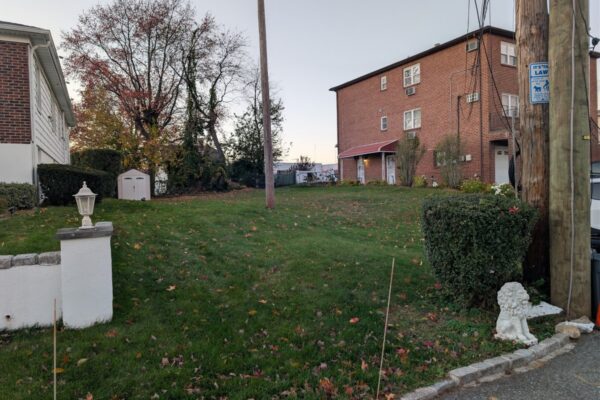
On Sept. 15, the authority issued a call for developers interested in building affordable ownership housing on seven parcels of authority-owned land across the city. Southwest and southeast Yonkers contain three parcels each, with a seventh in northwest Yonkers.
“We’re not talking about thousands of units right now,” says housing authority general counsel Brendan McGrath. “We’re talking about probably a handful to get started.”
While development possibilities remain open-ended, the “general model” for affordable ownership housing entails building a multifamily home and matching it with a buyer, who can rent out the other units to help pay the mortgage, McGrath says. “In 20, 30 years, the house is theirs and it’s a win-win really for everyone.”
The authority bought the properties from the city, with the Yonkers Industrial Development Agency acting as an intermediary. The properties were deemed “defunct” due to abandonment or foreclosure, McGrath says. The Ledger verified that each plot of land is empty.
The initiative will draw on HUD money to fund planning and construction, McGrath says. Developers may also suggest financing ideas.
Negotiating contracts and starting construction could take up to six months, McGrath estimates. He couldn’t say when people could move in.
Everything but Your DNA
For Own in Yonkers applicants, house hunting comes later.
At the library session, Alcantara and fellow co-director Cindy Gago emphasized that the application process entails significant work. For instance, required documents include “everything but your DNA,” Gago joked.
Along with forms and identification, applicants must submit detailed evidence of any and all income and assets, Gago says. Those with more than $200,000 in liquid assets cannot qualify, although retirement accounts are excluded.
Applicants are responsible for property inspections, real estate agent and attorney costs, and required repairs. After closing, violating the program’s terms will require full or partial repayment of the down payment assistance. Violations include moving out or trying to sell the property within five years, according to the nonprofit.
Applications for the program opened Nov. 9 and are due whenever “you’re ready with all your documentation,” Alcantara cheerfully told info session attendees.
“Let’s be real. Some of us are not ready,” she said. Still, she encouraged the crowd to keep the faith. “It might take you six months. It might take you a year, but you could do it, because if it’s credit … you could fix it, right? If it’s debt, you could pay it.”
Marlon Castillo, a 41-year-old bus driver who attended the session, plans to be among the first to apply. “Absolutely, I’m applying,” he said. “Right away.”
Castillo is a renter. He had previously secured a mortgage pre-approval with 15% down and hoped to score a single-family home for his family of four, but “it looks like maybe that might not be the case,” he said.
With the down payment assistance program, he added, that dream might be back on the table.
“Everybody knows home ownership is the best way to build wealth,” he said. “Nineteen percent with a 1% out-of-pocket cost, you’re saving tens of thousands of dollars.”
Fuentes also says she plans to pursue the application. “It’s a lot, but anybody willing to give you 19% [for] a down payment, I don’t think it’s just gonna be like ‘here’s the money, go do whatever you want,’” she says. “I’m willing to see it through.”