On the second day of school, a voice came over the intercom at the Robert Halmi Sr. Academy of Film and Television. The main office was searching for a lost phone pouch belonging to an eighth-grader.
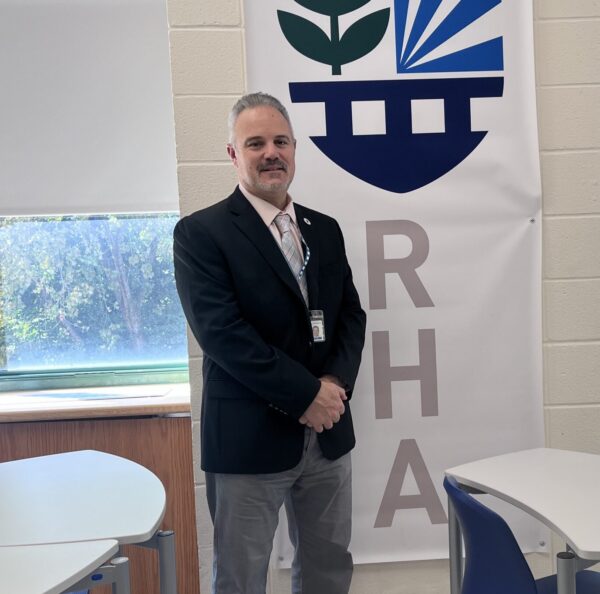
Downstairs, a few ninth-graders were still searching for their first-period classroom. They were the newest arrivals at a school that adds a grade every year and does not yet have a senior class. “Just a few students came in not really knowing where to go,” Principal Mark Ametrano said, “but those are really the brand-new students to our school.”
It’s a typical beginning-of-school scene in a school that’s unlike any other in the city. The academy takes its name from Robert Halmi Sr., a prolific film producer, and part of the school’s mission is to train students for jobs in the film industry.
Graduates may not end up in glamorous jobs like acting, directing or producing, but with skills learned as teens, they may stand a better chance of finding well-paying, unionized jobs in film. And with several large sound stages opening in Yonkers over the past several years, those jobs could be here.
Misael Sanchez, who helped write the school’s film curriculum, is careful about that promise. “There is not a single place on the planet that can guarantee you a job,” he said. What the school can offer, he said, is access. “Filmmaking is a people’s business,” he said. “It’s a connection. It’s knowing someone is sometimes more important than knowing a skill.”
This fall,the academy enrolls grades 7 through 11, with about 325 students. It will reach capacity next year, with grades 7 through 12 and a June 2028 first high school graduation.
The academy was created in partnership with Great Point Studios, the primary operator of the new Yonkers stages. Lionsgate Studios, operated by Great Point, opened in downtown Yonkers in January 2022. The property the school sits on is also the site of a proposed studio campus — it was previously the campus of Rising Ground, a major family welfare agency that for many years operated a residential program there.
National Resources, a real estate investment company, paid $52.6 million for the campus in 2022. The company owns the school building, which was a Rising Ground school as well. The city leases the school.
How the Curriculum is Designed
Inside, the academy runs as a Yonkers public school with a film program built onto it.
“We are a public school in New York state, so we follow all the requirements that the New York state public schools require,” Ametrano said. Students take math, English, science, social studies, physical education and a foreign language, plus one period a day of film.
Seventh-graders take an introductory film course. Eighth-graders take a half-year of film, along with a course in career and financial management, and ninth-graders take one period a day of career and technical education in film. In 10th grade, students choose one of three academies — production, postproduction or design — and film moves to two periods a day.
Production covers camera work, lighting and scene setting. Postproduction is video editing, sound editing and special effects. Design includes “set design, costume design, hair, wig, makeup and character development,” Ametrano said.
High school students also choose visual art, orchestra, theater or dance toward a 4+1 arts pathway credit. Middle school students rotate through the arts.
Alexsandra Hernandez and Alexander Torres are both juniors in the academy’s production track.
Torres, 16, said the track moves through lighting, camera and sound across three years, and that this year’s focus is camera. His team’s final project last spring was a music video recreation built around “Ghostbusters.” It won best use of lighting — an award, he noted, that “was just within the school.”
Torres said he wants to pursue media communications, possibly in a government office or in journalism. He said his family was supportive. “This school wasn’t necessarily something that I would have expected to be coming to, but I saw it, and I thought it’d be a great opportunity.”
He hadn’t known the studio was there. “I knew Lionsgate had their area there, but I didn’t know about Great Point until I got here.”
Hernandez, 15, works in the director’s role. “I find that more interesting,” she said of directing. Her class is learning manual focus this year: “The autofocus has been removed, so we need to learn how to focus on the actual camera.”
Her team recreated an Ariana Grande music video in 10 days, lost its location partway through and improvised the rest. She won best director and film of the year.
She transferred from Yonkers High School after a month there. “I felt so out of place,” she said. Ametrano had been her principal since prekindergarten at Enrico Fermi. Her parents were skeptical at first because the film industry is a hard industry to get into. But now they’re fully supportive.
She wants to teach. “Ever since I was little, I wanted to become a teacher,” she said — and now film specifically.
Matching the School to the State
The academy began its third school year last month. It opened in fall 2024 with 153 students in two grades: 74 sixth-graders and 79 ninth-graders, building a middle school and a high school at the same time.
Getting the program approved took work. New York state has career and technical education pathways for film, Ametrano said, but they did not match what the school wanted to teach or the licenses its teachers held.
“For what we wanted to teach it did not exist based on the licenses,” he said. “We had to work to match the existing pathways.”
The school spent its early months lining up its three academies with the state’s existing pathways until the program could be approved. Ametrano credited his assistant principal, Matthew Gonzalez, and the school’s two career and technical education coordinators with the bulk of that work. “I don’t want to take really much credit other than guidance.”
Ametrano makes the case for trades in general rather than for film specifically. “I feel like we as a country have gotten away from the importance of the blue-collar worker,” he said, noting that the trades offer “a good job with a union backing you, with health benefits.” Friends of his in the electrical and HVAC fields, he said, are struggling to find qualified workers.
Film, he said, is the same argument. “There are so many people that have to work to make a film successful,” he said, and students can leave high school with a skill set “that a lot of students don’t even get out of a film school coming out of college.”
Ametrano came to the academy from the Enrico Fermi School for the Performing Arts, where he served as principal for nine years. This is his 30th year in Yonkers and his 12th as a principal. He said he heard rumblings that a film school was coming and was later asked to run it. “I really wasn’t part of the planning process.”
He described taking the job as a chance “to reinvent yourself” late in a career, and the school itself as “kind of an experiment” — a public school built in collaboration with a private company, a structure he said exists in few other places.
Asked how a brand-new high school squares with declining district enrollment, Ametrano said the academy keeps students in Yonkers who would otherwise leave it. Parents applying to performing arts schools in the city told him they wanted their child to stay in the district. If they didn’t get into the academy, “they were going somewhere else, and they weren’t going to another public school in Yonkers.”
Building It From Scratch
The people who wrote the film curriculum came through Great Point. The school’s two career and technical education coordinators, Sanchez and Donella Alanwick, were identified and brought in by the company, Ametrano said.
Sanchez had spent 15 years at Columbia University’s graduate film program, where he was head of production and taught cinematography, and 17 years at Sarah Lawrence College, where he chaired the film program in his final year.
Sanchez said there was no well established model for teaching filmmaking at the high school level, so they started from scratch. The idea, he said, is “teaching below-the-line crafts,” meaning the jobs that aren’t directing, writing or producing. They worked with the International Alliance of Theatrical Stage Employees, known as IATSE, on what graduates would need to know to join the union.
On the second day of school, a banner stood in an upstairs corridor, with the academy’s crest, the Great Point Studio logo, the two Yonkers Public Schools logos. The public-private partnership has allowed the school to become fully equipped. Great Point has donated cameras, televisions and computers and has helped with transportation to the studios and on other trips.
Ametrano said the company has brought in guest speakers, including set designers and young filmmakers. The actor Jon Hamm visited in May while filming in Yonkers, and Don Cheadle ran a master class in June. During a visit from an Arri camera representative, students handled a camera the school said was worth $175,000, and they saw the stage where a digital LED wall stands in for the view through a car window.
Cheadle’s connection goes further than one class. The academy belongs to a national network of film high schools backed by a foundation Sanchez said was formed by George Clooney, Cheadle and others. The network includes the Roybal film school in Los Angeles and schools in Brooklyn and Atlanta. When the academy needed a computer lab, Great Point donated half the machines and the foundation paid for about 10 more, he said.
Ametrano credited Robert Halmi Jr., the company’s founder and chief executive, with backing them. Halmi Jr. is the son of the school’s namesake, and the two worked together producing films for many years. Halmi Sr. died at 90 in 2014.
He was also specific about where the partnership stops. The district and the city pay for staffing, not the studio. “Great Point does not pay for teaching employees,” he said. Their role is to support the film curriculum, bring in guest speakers, and give students access to industry events.
Internship Programs Now Being Planned
Ametrano said internships are coming — “Great Point Studios will be taking on interns from our school,” he wrote in an email — and that the company and the coordinators are working with other businesses to place students. But he said that just how many will be placed in internships hasn’t been set.
According to Sanchez, there’s an unpredictable element in the studio business that makes it hard to plan the internships far in advance. Great Point has the stages, but the productions renting them decide who works on set. “Great Point Studios is a thing, but the production companies are another,” he said, listing Apple TV, Netflix, Paramount and Lionsgate. The next step, he said, is persuading those productions to take students.
He estimated the school will need to place about 80 students a year. Placements could rotate through the studio or run through Great Point companies such as Hudson Scenic and GPS Lighting, or involve shadowing stage managers. The conversations are starting this year with the 11th-graders, and he said the administration side “could be glacial.”
Asked whether he thinks these students end up with jobs in the industry, Ametrano didn’t oversell it. “I think so,” he said. “No job is guaranteed.” Not every student will pursue film; some choose the school for other reasons and are enjoying it. His own goal for them is a four-year college first.
“We’re giving them a foundation,” he said, “and they’re going out there, and they’re figuring out other things.”