When I meet people for the first time, I often wonder about the untold stories inside them. I hope they’ll share something intimate, provocative or amusing, so that I’ll catch a glimpse of their character and an inkling of what their life is like.
And so it is with trees. They too have stories to tell, and if I pay close attention, I’ll hear them. Although we can’t converse, I sometimes feel the trees are speaking to me.
On a glorious Halloween morning, while walking in the landscaped woodlands of Untermyer Gardens, I came across a pair that I’m convinced wanted to be heard.
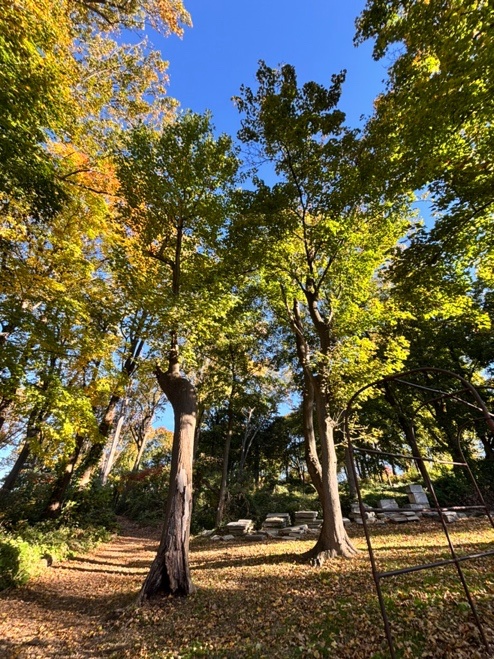
They’re not the most imposing specimens. In truth, they’re rather small, nothing special really, easily overlooked. Upon closer inspection, it’s clear their time is short — they’re nearing the end — worn down by the hard lives they have led that didn’t amount to that much.
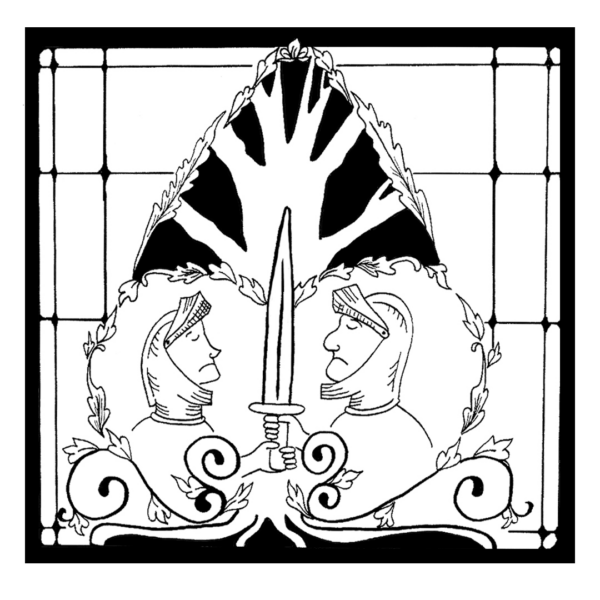
But they are warhorses — aging knights engaged in one last battle. To live as a tree in the forest — even in a manicured one like the woods of Untermyer — is always survival of the fittest.
The tree on the left is a battered and beaten tulip — an important native species in Northeast deciduous forests and among the tallest. But not this one. Its trunk is hollow, and it leans precariously at a 70-degree angle. About 10 feet up, there is an enormous scar where long ago it lost its central leader — the main stem that supports the primary branches that give the tree its shape — probably from storm damage or disease.
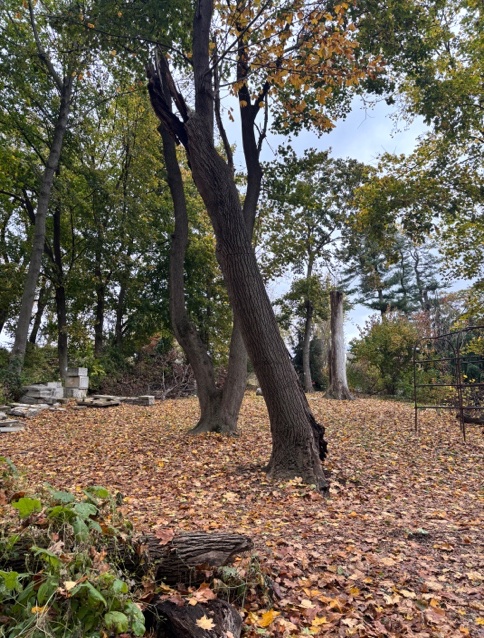
Nevertheless, this tulip soldiered on. Refusing to die, its strong root system sent up a watersprout — a vigorous, vertical shoot that grows from a tree’s trunk or branches, often in response to damage or stress. In football parlance, it was a Hail Mary pass at the end of the game, a long shot to replace its lost leader as time on the clock was running out. Against the odds, it took hold and sprinted up towards the heavens to capture the sun.
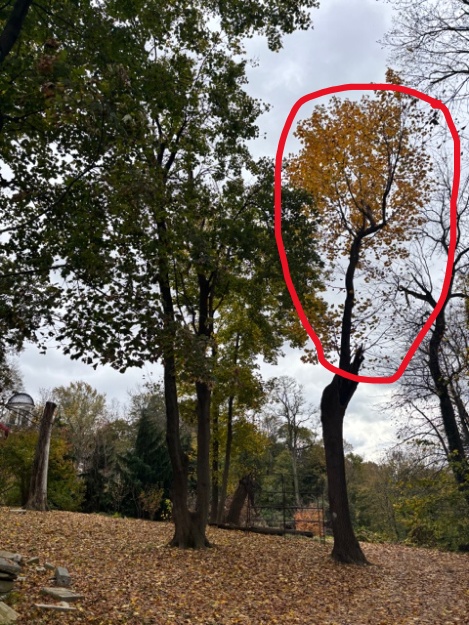
The story, however, doesn’t end there. Ten feet away stands a Norway maple, a non-native species I’ve written about before and don’t like. Found everywhere in Yonkers and throughout the Northeast, it was widely planted as an urban street tree, especially after Dutch elm disease devastated the American elm. These unfriendly maples are invasive because they don’t support the native ecology and grow aggressively so that they outcompete more desirable native trees, eroding biodiversity.
But maples are not immune to disease, and this one appears to suffer from a fungal infection (verticillium wilt) that causes upper branches to die back unevenly, while lower branches continue supporting the tree through photosynthesis. Not far from the trunk, I saw a large section of a branch lying on the ground — as if lopped off by a swift sword — that until recently filled the gap in the tree’s canopy, a telling sign of this fungal affliction. Norway maples are susceptible to verticillium wilt — a soil-borne fungus that enters the tree through its roots.
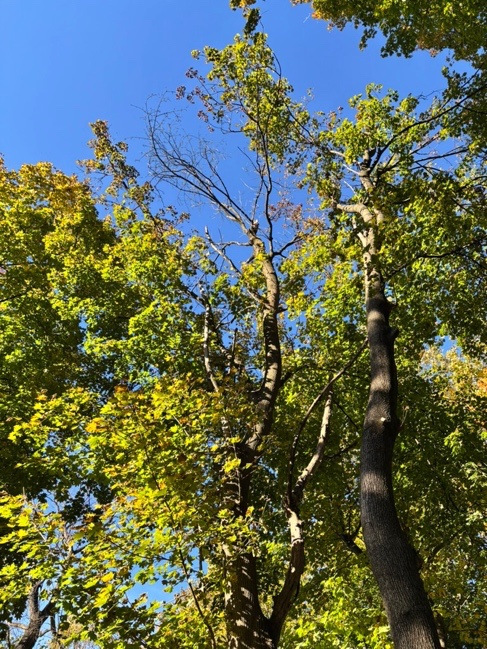
But like its rival, the neighboring tulip, this weary knight of a maple battles on. To compensate for its own lost leader, it too urgently sent up a watersprout to recapture the canopy it was slowly losing.
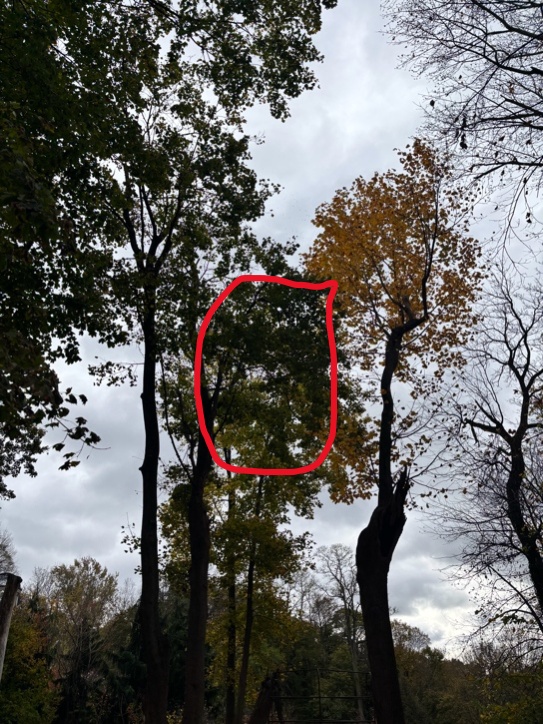
These trees are not going gently into the night. Instead, with their last gasping breaths, they fight each other for every inch of sky in an attempt to capture the sun’s energy and restore themselves to former glory. It’s what these soldiers do.
So, who will win? If they were to be left alone, my money would be on the maple. It’s in better shape and, because its growing season is longer than the tulip’s, its watersprout is growing faster and already overshadowing the tulip’s watersprout. In this desperate battle, capturing the sun means life for one and death for the other.
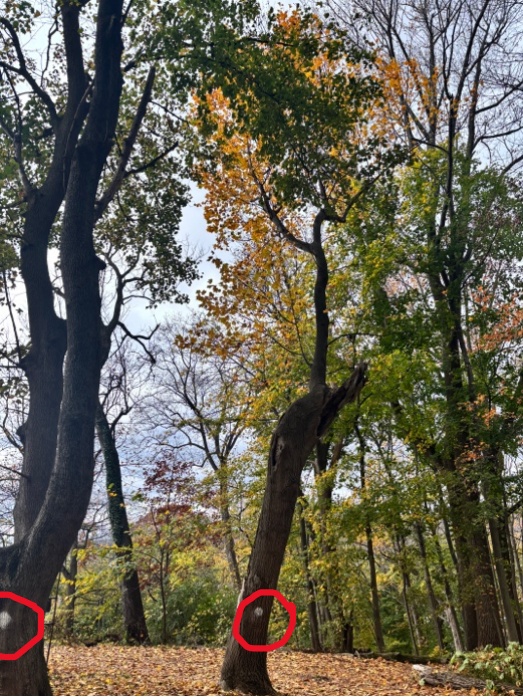
But while this battle rages on, there is a third combatant who will undoubtedly have the final say. Both the tulip and the maple have been marked with a telltale white spot — a sure sign that the Untermyer arborist and his chainsaw are on the way. I expect that this time next year both will be gone and their futile struggle for survival forgotten except in these pages.
Let’s salute their effort. Steadfast knights of the Untermyer woods.