
The National Theatre (of Great Britain) was formed in 1963 by, among others, Laurence Olivier, who directed its first production, Hamlet, starring Peter O’Toole. That’s a heady legacy for any company to fulfill, especially in a new production of the play that premiered in London last year, and is on at BAM Strong Harvey Theater until May 17.
Nobody in Hamlet makes it out alive.
Spoiler Alert, by play’s end, Hamlet is dead, Gertrude is dead, Claudius is dead, Laertes is dead. His sister, Ophelia, of course. Also, Rosencrantz and Guildenstern, the inept pawns caught in a battle between Hamlet and the murderous Claudius, who Hamlet’s dead father claims poisoned him. (Hamlet’s father appears as a ghost at the top of the play to goad Hamlet to avenge his death.) With centuries of Hamlets behind us, and with the National’s own legacy of productions, (Benedict Cumberbatch’s 2015 production of Hamlet is available to stream on National Theatre Live) there is a temptation to re-invent the wheel with each new undertaking. The play, of course, is up to the challenge.
BAM’s Hamlet Opens with Promise
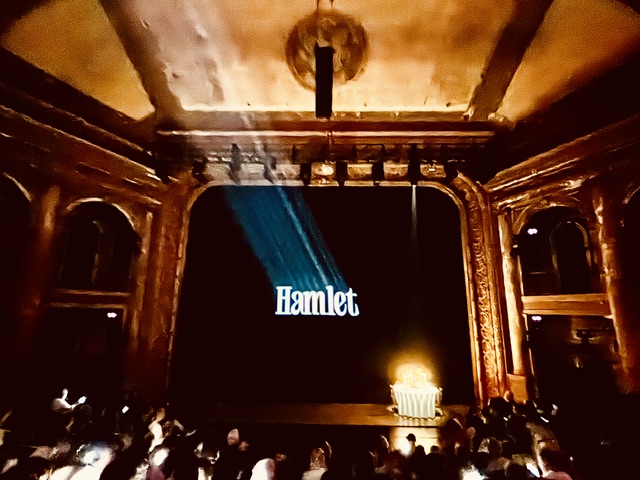
At its best, this production at BAM centers on questions of personal morality – how Hamlet navigates his way through the rapidly changing dynamics of his fractured family, and, even more pointedly, how we all might respond to the incorporeal forces that play upon us, especially, as with Hamlet, in times of rapid change and gloomy forecasts. There is a pulsing at the top of this production, and a soundscape, of recorded live musicians, that creeps under much of it. (Hamlet’s father’s ghost, played by the imposing Ryan Ellsworth, bellows in his first appearance. His mic’d and manipulated voice seems to explode out of his body.) The first scene suggests a Hamlet where unseen forces and incarnate forms will not only haunt the characters, but terrify them into action. It suggests that we, too, will be cast in the darkness, and made to find our own way forward. The production, though, fails to follow up on its own promise, and the gripping power of its first 20 minutes. Director Robert Hastie never re-captures the dark energy of his ominous opening. We are never as engaged as we are in the opening scene – when anticipation is high, and the audience is eager for a trip to the dark side. This Hamlet never gets as good as its first scene.
Hamlet Enters
Hamlet’s entrance in the production marks a disappointing return to familiar territory. The emphasis shifts – to Hamlet, of course, but also away from the external forces that compel him to action. The production becomes about how Hamlet figures out what to do, and, distinctly, how he talks to us about doing it. Hamlet has seven monologues in the play – each a step forward, or back, on the path to avenge his father’s murder. This production leans (too) heavily, though, upon how Hamlet speaks the speech. His soliloquies are played as asides – in direct address to the audience. They frequently come across as jokes, not the tortured musings of a conflicted soul. In this way, Hastie’s staging dilutes the soliloquies of their quiet power, and the play of its emotional thrust. Hamlet’s introspection get sucked into the void of the Harvey Theater. By the end of the First Act, Hamlet’s discomfiting dialogue with the audience threatens to overwhelm the tragedy.
Jokes Aside
At points, the production devolves into something resembling an episode of The Office, where characters step out and let us in on their secrets. It reaches the heights only when the story finally overpowers the comic bits and presentational staging. Hiran Abeysekera plays Hamlet at full speed, with the antic disposition of a disgruntled teenager. It’s a viable way for him to go. Abeysekera looks like a teenager. And moves like one – especially a teenager in some torment. His Hamlet is appropriately surly, if not outright contemptuous – especially of his step-father, who towers over the smaller Hamlet. (A size differential between the two actors that might have been exploited in another production.) In the context, it makes sense that Hamlet’s anguish is most frequently expressed in tantrums. Abeysekera hurls Hamlet into athletic fits of manic behavior. He wails in high-pitched rage, then scoffs at his own futility. There are underpinnings in Abeysekera’s performance that suggest a complex and tortured soul. And Abeysekera certainly seems capable of rendering a character caught not only in Hamlet’s immediate circumstances, but also, of course, in an existential crisis. But under Hastie’s direction, the performance never transcends its colloquial context. It is stuck in the familiar. It depends upon a contrived “wink and nod” relationship with the audience.
Monologues as Stand-Up?
Hamlet’s monologues are staged below the proscenium. They sometimes come across more as stand-up routines than meditations. Abeysekera’s performance occasionally teeters on petulance. There are lots of “look at me” gestures meant as much for us in the audience as to the court and his family. It’s not fully Abeysekera’s fault. Hastie’s direction leaves him and his
castmates to their own devices. He offers no sustained logic for the meta-relationship with the audience, nor does he encourage nuance. In his dynamic opening scene, placed in the darkened drawing room, not on the ramparts, Hastie gives the attendants and Horatio flashlights to track the ghost. They shine on us. It’s very clever. The idea of being looked at, though, is almost immediately abandoned. We are quickly put back in the dark, where characters face out and declaim. There is little intrigue in the production. What we see and hear is mostly what we get.
Ophelia’s Madness
The production has remarkably few memorable stage pictures or affecting moments. It does not suffer, though, for the occasional histrionic moment. Francesca Mills’ Ophelia’s madness scene (Act lV Scene Five) is one. Like Abeysekera, Mills certainly seems capable of a nuanced performance – one that might suggest innocence (or even guile) to Hamlet’s more obvious machinations, but her Ophelia is boisterous and bawdy – often looking out to us with self-satisfied awareness. It’s a strong, original take. (And great to see an empowered Ophelia, no matter the production.) But it also undercuts logic. Ophelia’s descent into madness in this Hamlet is more about an actor let loose on the stage than it is the portrait of a character’s lost virtue and plummet into madness. It is certainly the most full-out and dynamic performance in the production. In the context, though, it feels out of place. We have not seen the effects of the damage done to Ophelia’s innocence and sensibility that would prepare us for this frenzied meltdown. There are no hints as to the level of Ophelia’s fragile state.
Gertrude is Ambiguous
While Mills has a strong point of view, other actors are oddly ambiguous. Ayesha Dharker’s Gertrude seems impervious to events, and her son’s anguish. Her performance hints at neither consummate devotion to Claudius that might make her blind to Hamlet’s innuendoes, nor empathy for Hamlet’s deteriorating state of mind that might provoke doubt in her relationship to the new King. Dharker’s monologues do not capture the scope of Gertrude’s struggle. The confrontation between Gertrude and Hamlet in the bedroom scene (Act lll, Scene 4), “Look here upon this picture, and on this, The counterfeit presentment of two brothers.” is disappointing. It lacks the shock of recognition, and the anguish of Gertrude’s plaintive demand of Hamlet, “What shall I do?”
Polonius Restrained
Matthew Cottle’s Polonius is a bit restrained – unsure it seems, of how addled the character might be, or if he is just a caring father prone to repeating his own stories and counsel. (Ophelia seems to have heard and memorized everything he has said before.) Ryan Ellsworth’s Gravedigger is a bit big. The Yorick scene lands heavy. The banter of the First and Second Gravediggers is a parallel to Hamlet’s own conversations with Horatio. Inthe play, we are meant to see how close one world is to the other, and how indifference to the dead becomes a way of life. The scene foreshadowsHamlet and Laertes’ final battle and their own deaths. In this production, it lacks bathos. It is all too bright and too loud.
The Play within the Play
The play within the play, The Murder of Gonzago played before Gertrude and Claudius and the court, and meant to expose Claudius’ murder of Hamlet’s father, is also stuck between worlds. It’s hard to tell if Hastie is spoofing his “actors,” as Shakespeare does with the mechanicals in A Midsummer’s Night Dream, or if they are to be taken at face value. Either way, Hamlet’s directions to the players falls flat – lacking comedy or urgency. Other than his gripping opening, the scene does make for one of the few memorable stage pictures. (Though, in itself, references another production of another play.)
Staging Lacks Point of View
Hastie’s staging often lacks distinct imagination, and wastes the potential of Ben Stones’ intriguing drawing room design, with its dramatic forest and soldiers-at-war wall-coverings, and multiple entrances and exits. Aside from the players scene, and his opening flashlight tease, only the rising wall at the end of the play, and the death of Polonius, which makes clever use of a gun and spouting wound, are particularly evocative images. The duel at the end of the play is done quite well. The all-white fencing uniforms (Ben Stones also designed the costumes) make a powerful statement – one of few in a Hamlet that leaves us wanting more imagination and a stronger point of view.
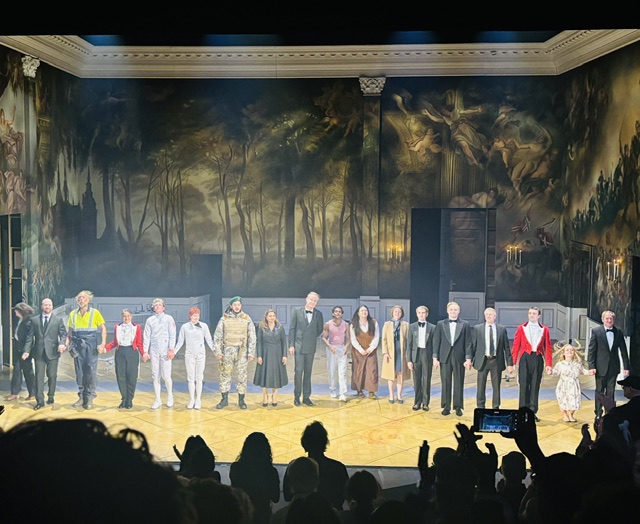
HAMLET by William Shakespeare
BAM Strong Harvey Theater
Thru May 17
Professor Kevin Confoy teaches theater at the Undergraduate and Graduate Levels at Sarah Lawrence College