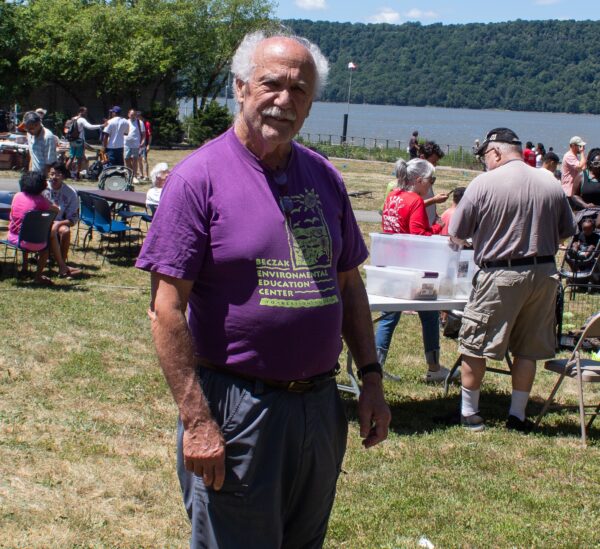
Sometime last Friday, Ludlow Park resident Dr. Rob Morrow smelled something he describes as “sickly sweet.” Only later did he learn that a power failure at the Westchester County Yonkers Joint Sewage Treatment Plant had caused a discharge of 39 million gallons of chlorinated sewage into the Hudson.
“Something went wrong in the main processing of the plant, so they went to the emergency stuff, and they couldn’t get it to work properly,” he said Sunday. “So they just dumped into the river 39 million gallons of chlorinated poop. Bad stuff. Sewage stuff.”
The spill lasted from the night of July 2 until 1:45 p.m. Friday. In an email statement to the Ledger this afternoon, a Westchester County spokesperson repeated the county’s initial explanation for the breakdown. The plant “experienced a complete power failure for the first time ever as a result of Con Edison’s emergency power reductions during the recent period of extreme heat,” said Communications Director Catherine Cioffi.
“Although the facility’s backup generators operated as designed, the reduced power supply placed significant strain on critical treatment equipment, causing the backup generators to fail,” she said. Operations resumed after engineers reconfigured the power supply in a way that “would not be impacted by the Con Ed power fluctuations in power due to the extreme heat.”
While last week’s accidental discharge involved sewage dumped in the river, the emissions that most concern Morrow are airborne: microplastics produced by the flares that burn off the methane the treatment process generates.
At the plant, leftover sludge is processed separately, releasing methane gas as a byproduct. The plant burns this gas to power its own engines and boilers, and whatever is left over exits through the flares. In Morrow’s view, those flares are at the epicenter of the neighborhood’s potential health concerns. State data shows that the areas around the plant are among the unhealthiest in New York, with sharply elevated rates of premature death, heart attacks, asthma and other ailments.

Regulators do not inspect for microplastic emissions; federal regulations don’t require it. But Morrow says he and his students have been finding small particles in samples from the river, taken near the plant’s outflow pipes. Under a microscope, the particles appear as irregularly shaped spots of red, blue or black. The number of particles in the samples is extremely high, he says, peaking between 10 p.m. and 5 a.m., when the plant is releasing water into the river.
Morrow says both the data and his personal experience convince him the emissions are taking a deadly toll. “When you get microplastics in your bloodstream, the two major features that you see are basically more localized cancers, mostly pancreatic, and various blood vessel diseases, inflammatory diseases give you aneurysms, and we’re very high on that, and we have no reason to be high on that, except for the plant.”
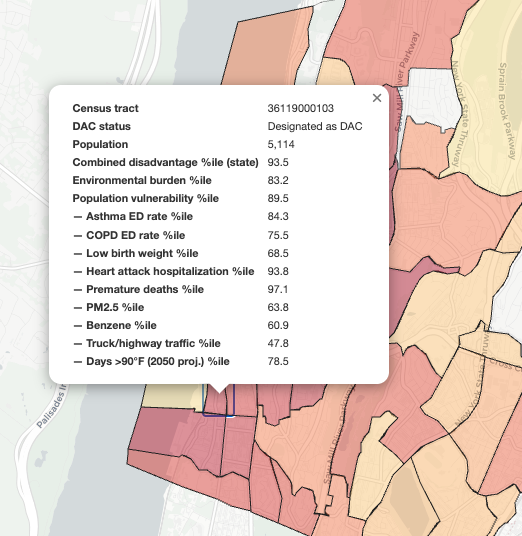
According to the state’s Climate Justice Working Group, the neighborhoods adjoining the plant qualify as “disadvantaged communities.” The neighborhood’s census tracts rank in the top 10th percentile of disadvantaged communities — 90 percent of the state is healthier than these tracts — with rates of premature death in the 97th percentile.
“Does sound like a smack in the nose,” Morrow says of the health data. “It ain’t Harlem, and it ain’t … Brooklyn … there’s a lot of places in New York that you would imagine have worse numbers.” In other words, while much of the neighborhood is economically disadvantaged, socioeconomic indicators alone don’t explain the data.
Premature death is defined in the U.S. as death before age 75. The most common causes include heart disease and stroke, as well as cancer, injuries, respiratory disease and diabetes. Other health outcomes that place the tracts in the top 60th percentile or worse include heart attack hospitalization, asthma emergency admissions and low birth weight. Adverse environmental factors include elevated heat, proportionately more truck traffic and environmental benzene.
“I can attest to a lot of my friends dying young, but that, of course, those are just my observations, as opposed to real numerical things,” Morrow says. “Numerically, early death includes very poor people, immigrants, undocumented people, but it also includes people who live near the sewage plant.”
“There is one street where every house has someone who died of pancreatic cancer or some other inflammatory heart disease,” he says. The cause remains unknown, in part because the county doesn’t conduct autopsies for these deaths. “The ones who have had autopsies were found to have inflammatory aneurysms — they’re something that blew up near the heart, and that’s kind of what you would expect from small plastic particles.” Morrow frames this with a caution: “a suspicion without real evidence of a connection.”
The Yonkers Ledger contacted the Westchester County Department of Environmental Facilities for comment on Morrow’s allegations about the health consequences of microplastics produced by the flares, but the department has yet to respond.
Morrow doesn’t equivocate. On the management of the sewage plant, he says: “The people at the plant have told us that if Washington doesn’t want us to do it, we ain’t doing it. They said it to my face.”
He has found little support at the city level. He sits on the Yonkers Green City Advisory Committee, which he says “has been extraordinary in being totally indifferent to the issue. They don’t discuss it.”
A few weeks ago, he was helping out on a sunny Saturday at Beczak, where a community event included live jazz, a kayaking competition and many, many turtles. He chatted with visitors, worked the barbecue and fixed the coffee machine. Morrow’s students come to him through Beczak’s educational programs.
He took a moment to show a guest the Hudson shore and the kayaking club next to Beczak’s new riverfront marsh, then walked to the other side of the building, where a construction site sits. “They built a big chlorination plant behind the boathouse,” Morrow says, referring to a large tank meant to manage overflow from the main Yonkers plant. “First, they wanted to take away the boathouse. Well, we didn’t let them do that.”