

It’s exciting to be back for Season 2 of A Tree Grows in Yonkers. After all, trees are life! The world as we know it couldn’t exist without trees. And just think — where would Yonkers be without them?
100 Great Trees Out of 280,000
Season Two kicks off with our first serious effort at reader participation: I’ll need your help as we start to make our list of 100 Great Trees in Yonkers. I’m not necessarily looking for the oldest or tallest, although certainly those are of interest.
Tree greatness is subjective: what’s great to me, might not be to you. It’s up to you, our readers, to help me expand my tree consciousness. Give me your help! Tell me about your favorite trees! I’m asking all tree lovers out there to join the Great Tree Compilation of 2026! Do you have a favorite in Tibbets or along the Croton Aqueduct? Maybe there’s a hidden gem in your neighborhood school yard or park. Let me know, and I’ll check them out, and perhaps they’ll make the list.
As the list grows, I will be creating a map of the anointed trees, which will be posted on the Ledger.
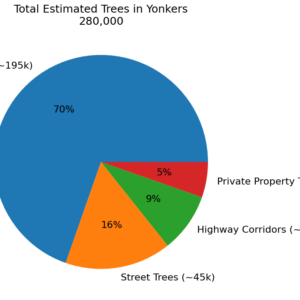
To better understand the task ahead, I asked several AI programs “How many trees are there in the City of Yonkers, NY?” Chat GPT estimates there are approximately 280,000 trees (my gut tells me this is a conservative estimate), based on a 40% canopy cover which is consistent with other Hudson Valley cities.
There’s an estimated 195,000 in city parks; 45,000 along city streets, 25,000 along highway corridors, and 15,000 on private property.
With so many to choose from, I’m pretty sure we can come up with 100 favorites. We just have to seek them out, and when we find them, tell their stories.
From Season 1, I’ve selected 4 trees for the list: the Bronx River Beech, the Lonely Northern Red Oak, the Tulip Monster, and the Burly White Oak – only 96 more to go. You can read about these trees in last season’s stories here.
The Great Kimball Shagbark Hickory
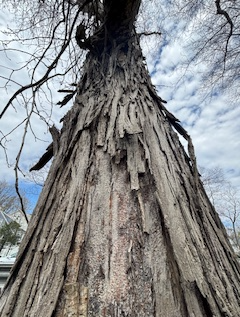
The first tree I’m adding to the Season 2 list is shown in the story’s top photo. I’m calling it the Great Kimball Shagbark Hickory. I often drive past it heading south on Kimball Avenue away from the Cross County Mall. The tree is striking: it’s easily the tallest along this stretch of road, and it sits alone in one of the only side yards in the area, a space big enough for another single-family house. The yard is surrounded by a red fence next to an old stone retaining wall. I think the property owner must really love this tree, and so do I.
After driving by several times this winter without stopping, I thought the tree could be hickory because in the beautiful silhouette, the lower branches are turned downward. A characteristic of hickories that stand alone in a field. When I finally did stop and approach the tree, I saw the shaggy bark, which sealed the deal.
A Bit about Hickories
Long before Yonkers became part of New York’s urban landscape, hickory trees were essential to the well-being of the Eastern Woodland peoples, including the Lenape. Their nutrient-rich nuts were laboriously processed into hickory milk, a dependable food source, while their tough wood made excellent tools and firewood.
When European settlers arrived, they quickly recognized hickory’s utility, adopting it for tool handles, wagon wheels, and fuel. Its strength and reliability made it indispensable in frontier life, and the tree’s reputation for toughness, most famously led to the nickname “Old Hickory” being given to our 7th President, Andrew Jackson.
Today in the Northeastern deciduous forests hickory trees are becoming increasingly more important to fill the void created by the loss of ash and more recently beech trees as they have succumbed to disease and blight. In fact, when I spoke to a Westchester County Park Department conservationist, Taro letaka, last autumn, he told me the County will be experimenting with hickory trees to replace some of the dying beech.
Here’s a few fun facts. In the forest, certain bats that are now considered endangered because of habitat loss make their daytime roosts under the grooves of the shagbark’s shaggy bark. Naturalists today make a smokey, caramel syrup by boiling down shagbark bark. And, of course, for you BBQers, hickory chips on the charcoal will add a wonderful smokey flavor to your meats and poultry.
So the next time you’re driving on Kimball see if you can spot this amazing shagbark hickory. I won’t tell you the address, it’s fairly easy to spot. But don’t take your eye off the road.
A Tree Grows In Yonkers is a series by Phil Zisman. You can read more of the past series at The Yonkers Ledger. If you have a tree you love or would like Phil to cover, write him at [email protected]

