A line forms on the ground floor of the downtown public library, the portal to the Yonkers Public Schools. A staffer at the entry asks why you’re there, then sends you ten feet to a second desk. Out comes your folder — birth certificate, immunization records, utility bill. Three proofs of residency are required, all dated within the last 30 days, and a family that brings two goes home to find a third.
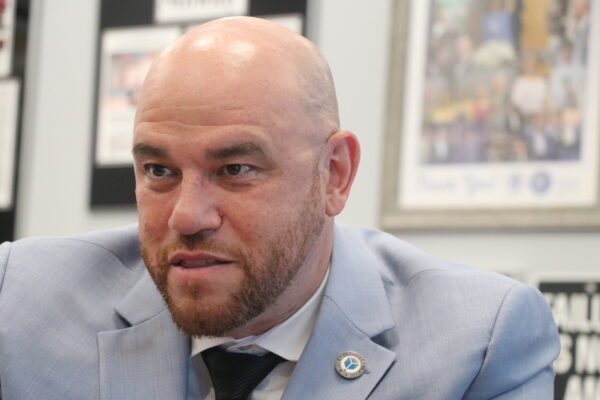
Past that desk and deep inside the administrative fortress, on a day about two weeks from school opening day, Superintendent of Schools Aníbal Soler is surprisingly relaxed. He recently closed a school, moved three cohorts of seventh and eighth graders into a new building, and also survived another round of Albany budget talks with Mayor Spano — emerging with school programs mostly in place.
And on top of all that, last year Soler implemented a cell phone ban, a policy that has challenged the youth of Yonkers to survive long days without TikTok.
Unfazed by the Job
Soler, 49, is confidently entering his third school year in office, giving the impression that he is unfazed by the job.
He has reason to be content. As the Ledger’s accompanying report card shows, elementary reading and math scores have moved closer to state averages. But the good news thins out in the higher grades. Although the graduation rate is holding at 90%, chronic absenteeism in the high schools is at 52% and Regents results trail state averages, particularly in math and science.
Newer results are in. Yonkers scores dipped this year, Soler says — the detailed 2025-26 scores won’t be public until November, when the state posts them. The district already has them and is putting them through a pre-release verification process. A leak of the New York state scores to Chalkbeat showed a five percentage point decline in reading for 2025-26, while math ticked up, and Yonkers followed the pattern — down in reading, flat in math. (See The Ledger’s 2026 School Report Card for more on Yonkers’ scores.)
Sneak Preview of 2025-26 Scores
“We mirrored the state,” he says. “We saw a little bit of a dip in ELA, and in math we were dead on.” Soler doesn’t seem worried. “I want to always beat the state average, you know, but we’re consistent with the state average. We’re not far off, and when we look to our sister communities, we are doing well. We had many [Yonkers] schools show growth, which is also really important. We dipped about two percent in our ELA.”
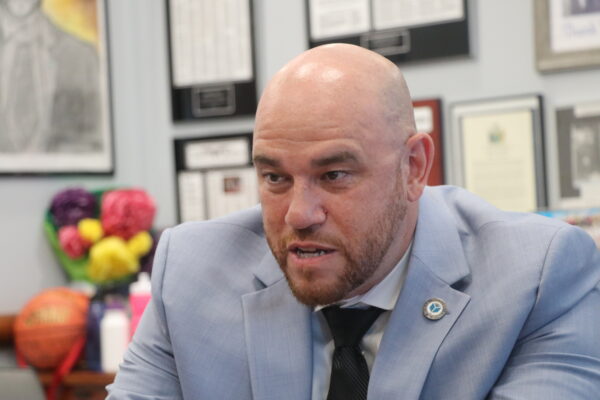
Soler fields questions deftly, like the college point guard he was — three seasons and a captaincy at Daemen College outside Buffalo, class of 2000. When he’s asked about one of the district’s most puzzling metrics — a chronic absenteeism rate that climbs to 52% in high schools, in a district that graduates 90% of its students on time — he’s quick to reframe the issue.
“We don’t talk about chronic absenteeism in affluent communities because they have different ways of labeling it,” he says. “‘My kid’s on a travel basketball team.’ ‘They’re on college visits.’ Those kids are chronically absent all the time, but they still perform well, so they don’t talk about it like we do.”
The 52% chronic absenteeism rate hides a wide variation from high school to high school in the district. A chronically absent student misses 10% or more of enrolled days. A student enrolled for the full 180-day year would miss at least 18 days.
At Saunders High School, the rate is 31.7%. At Gorton, it’s 68.9%. In nearby Mount Vernon, a system with a comparable poverty rate, it’s 23.3%.
And while Scarsdale and other wealthy Westchester towns may have students who miss days to visit Harvard, those systems don’t end up with the Regents scores Yonkers high schoolers post. Regents pass rates in Algebra I and biology lag the state’s by about 15 percentage points — and passing requires only a 65. Only 9% of the class of 2025 earned the Advanced Regents diploma.
Asked about the Regents, Soler downplays their value, noting that the Board of Regents has voted that the Regents graduation requirement be replaced by different standards meant to be more reflective of college readiness. “One of the proposals is that the Regents will go away,” Soler says. “The Regents exams will be decoupled because they were not intended to be the measure of intellect.” For now, the exams still count: the Regents requirement will be phased out through the end of the decade. Students will still take the tests.
Even with the high absentee rates and the low Regents scores, Yonkers maintains a high graduation rate. Ninety percent of the city’s high school students graduate on time — the highest rate of any big city district in the state. That rate has held since 2020, and it is the marquee number touted by Mayor Mike Spano and other city officials eager to promote the city’s schools.
So what about the students who don’t get the diploma? “When you look at the 10 [percent] who don’t graduate in four years, that’s where you start to see a large connection between absenteeism and a lack of motivation,” he says.
No Stranger to Tough Urban Schools
Soler knows tough urban schools. He grew up in Rochester and got his first teaching job there as a middle school art teacher, his college major. He would later spend four years as an administrator in Buffalo. Rochester graduates 60% of its students and posts 19% proficiency in reading, both last among the state’s big city school districts.
He took his first principal job in 2009 at East High School in Rochester, on the state’s “persistently dangerous” list until it was taken off two years later. The school still struggled academically, with a 42% graduation rate. He stayed seven years and brought in a partnership with the University of Rochester. He was on his way up the ladder of progressively bigger jobs, until landing as superintendent in Schenectady (pop. 69,500), and then three years later Yonkers gave him the call.
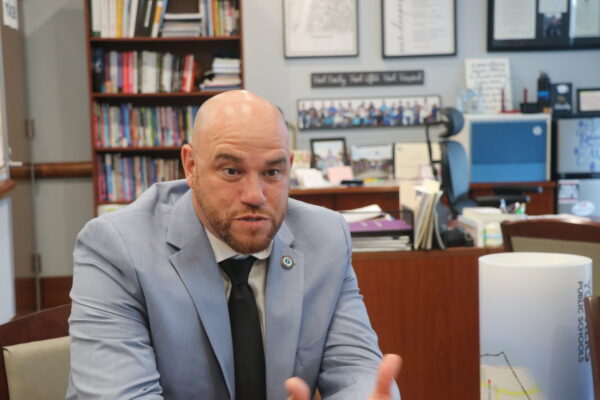
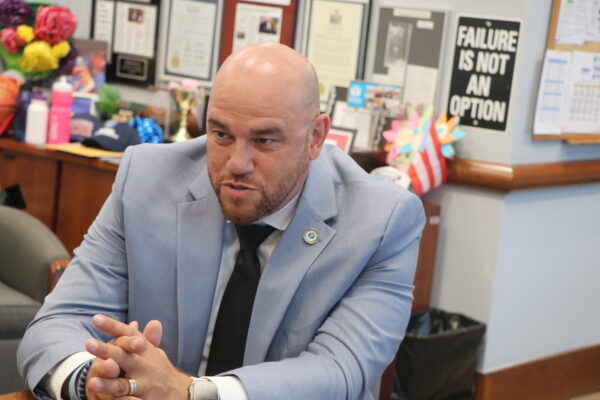
It was a major trade up — from the 35th largest school district to No. 3, with a salary topping $327,000. Now he sits in a CEO-level office, with several efficient-looking assistants in the anteroom. Yet the trappings don’t define him — Soler has an accessible, relaxed presence. He is built like the 6-foot-2 guard he was, shaved head, pale blue suit, black tie, district pin in the lapel. Charm is an asset for an administrator who runs an $822 million annual budget, in a system long hungry for cash that now has to make do with less.
For almost a decade school enrollment has declined, and the school budget has increased. From 2016-17 to 2025-26, enrollment dropped by 12.1%. At the same time, the budget rose by 42% over a period when prices rose 34%. The growth came from Albany, not City Hall: state aid rose 56% over the decade while the city’s share grew 16%, a cut in real terms. On top of that, $116 million in federal pandemic relief arrived in three rounds and ran out in January 2025. Most of the federal money paid for staff: art and music teachers, counselors, social workers.
Soler applied the brakes. His two budgets have risen by 2.1% and 1.4% — still growing while enrollment shrank, but marking a new era of restraint. “There has been a shifting demographic,” Soler says. “We’ve lost about 3,200 kids over the last decade. Which is a big deal, which has led to some of the school closures that we’ve had. It hasn’t been that we want to close schools, but we’ve had to use that as part of our budget closing measure.”
In the last year, the district closed an elementary school, School 21. School 25 closed the year before. The district also moved seventh and eighth grade students from three PreK-8 schools into Cross Hill Academy. The students come from Schools 16 and 23, and the Barack Obama School for Social Justice.
The cuts reach staff too. The district’s budget presentation eliminates 146 positions, though vacancies and retirements absorb most of them; the district estimates 27 people will actually lose jobs.
But the school reshuffling and other cuts don’t allow the district to keep up with rising costs. What’s driving the paradox of having to spend more to educate fewer students? “I think that what gets missed in the conversation is the rising percentage of students with disabilities,” Soler says. “One out of every four kids has an IEP [Individualized Education Program].” Most students with IEPs are placed in classes with one teacher and one aide. “So now that class that once cost me, let’s say, $100,000 is now costing me $200,000 to service the same 30 kids.”
Sharp Rise in Special Ed Costs
Soler says several major factors have driven the special ed increases, including more students diagnosed with autism and the impact of better-informed parents advocating for their children. Special education costs grew 50% in four years, to $84 million, with out-of-district tuition for high-needs students up 17% year over year, according to a district release.
Soler frames the growth as parents getting better at asking. “I think we’re getting better at it,” he says of the district’s ability to identify students with disabilities. “And in reality, think about this. Everybody should want an individualized education plan for their kid, right? And so I think there’s that sense of advocacy.”
Big-picture management and budgetary issues go on hold as the first day of school rapidly approaches. “I’ll be visiting a couple of our new principals as they start their journey. It’s always important to support our principals and it’s always important to be visible,” Soler says. “I’m a firm believer in inspecting what you expect. We want schools to look good.”
Late afternoon, it’s quiet at the front desk. The staff has gone home. The parents trying to find a school placement before the first day will be back tomorrow.